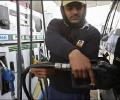
Fuel retailers sell diesel, domestic LPG and kerosene at government controlled rates which are below market price. The loss they thus incur is made good through cash subsidy from the government and dole from upstream firms like Oil and Natural Gas Corporation.

Diesel in Mumbai costs Rs 79.72 per litre at IOC outlets and Rs 79.79 at BPCL outlets.

ONGC on Friday said it hopes to begin marketing of LPG and Kerosene soon.
The country is facing no shortage of domestic cooking gas at the moment, Petroleum Minister Murli Deora told the Rajya Sabha on Tuesday. As on October 1, 2007, OMCs were serving 9.79 crore LPG customers through their 9,355 distributorships. OMCs have released 27.7 lakh new LPG domestic connections in the country during April-September.
Petroleum Minister Ram Naik said there was no shortage of domestic cooking gas in the country, as imports made up for the shortfall in LPG output arising out of the shutdown of a crucial unit in the Jamnagar refinery of Reliance Industries Ltd.
The government may permit Reliance Industries Limited to export surplus LPG from the west coast and allow it to import on the deficit east coast to make huge savings on freight cost.
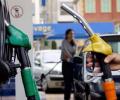
Petrol and diesel prices were cut by Rs 2 per litre each as state-owned oil companies ended a nearly two-year-long hiatus in rate revision, just hours before the general election schedule was announced.
Petrol and diesel prices were on Wednesday hiked in seven states like West Bengal and Maharastra and that of domestic LPG in six states as state-owned oil firms recalibrated rates to reflect changes in local levies.
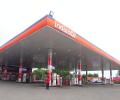
Indian Oil Corporation (IOC) on Tuesday reported halving of its March quarter net profit largely because of losses in the petrochemical business and shrinking margin after it announced a pre-election fuel price cut despite rising input costs. The net profit of Rs 4,837.69 crore in January-March compared to Rs 10,058.69 crore a year back and Rs 8,063.39 crore in the preceding October-December quarter, according to a stock exchange filing by the company.
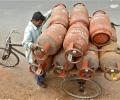
To cut subsidy bill and reduce fiscal deficit, the previous United Progressive Alliance government had restricted the number of subsidised domestic cylinders per household to six every year in September 2012, revising it to nine the following January
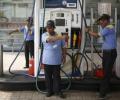
State-owned fuel retailers are losing close to Rs 3 per litre on selling diesel while the profit on petrol has trimmed due to recent firming up in international oil prices, industry officials said detailing reasons for continuing to hold retail prices. Indian Oil Corporation (IOC), Bharat Petroleum Corporation Ltd (BPCL) and Hindustan Petroleum Corporation Ltd (HPCL), who control roughly 90 per cent of India's fuel market, 'voluntarily' have not changed petrol, diesel and cooking gas (LPG) prices for almost two years now, resulting in losses when input cost was higher and profits when raw material prices were lower.

West Bengal Chief Minister Mamata Banerjee on Friday said that her government was willing to provide 'full relief' to common people and farmers hit by the increase in diesel price and restriction on subsidised LPG, if the Centre allowed the state to collect taxes taken away by it.
To contain misuse of LPG cylinders in markets, Indian Oil Corporation will soon bring out a system by which cylinder refills for domestic use will be coloured differently from those for commercial use. \n
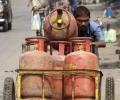
Indian govt must find solution to ever increasing LPG subsidy. Govt must cap LPG subsidy.
LPG demand this fiscal is expected to be around 11 million tonne, against around 10.2 million tonne last year. It is the subsidised price of LPG, which is available at around Rs 21 per kg for domestic use. LPG for industries, which is outside price control, is sold at around Rs 58 per kg, up from around Rs 36 per kg last year.
In a step towards dual pricing of domestic cooking gas, the government has decided to allow oil-marketing companies to sell the fuel at market prices in distinct fibreglass cylinders. IOC, BPCL and HPCL will sell these cylinders in Bangalore, Mumbai and Pune, which have been identified as test beds for the pilot project. The companies could revise fuel prices for transparent cylinders as LPG for them will not be subsidised. Feasibility of this project is yet to be adjudged.
RIL accounted for over a quarter of the country's LPG production of around 8.5 million tonnes per annum (mtpa) last year. Around 2.5 mtpa LPG - the only petroleum product in which India is not self-sufficient - was imported last year to meet the domestic demand of 11 mtpa. RIL is planning to cut LPG production at Jamnagar from 2.3 mtpa to around 1.6 mtpa from mid-2008 following the grant of export-oriented-unit (EoU) status to the refinery.
India will import five additional cargoes of LPG in November to meet the shortfall in domestic cooking gas created due to the unplanned shutdown of a crucial unit of Reliance Industries Ltd's Jamnagar refinery.
The EGoM was originally scheduled to meet on Wednesday but has been deferred because of non-availability of certain ministers in the grouping.
Close on the heels of a 70 paise per litre hike in petrol prices, the Oil Ministry is pushing for an increase in diesel and domestic cooking gas LPG prices, even though it is unsure of political support for the unpopular move with the ruling UPA alliance.
The government will allow exploration firm Oil and Natural Gas Corporation and Gas Authority of India to market domestic LPG to increase penetration of cooking fuel to 75 per cent of the population.
It proposed that smart cards be issued to BPL families for supply of subsidised kerosene in urban and semi-urban areas to cut diversion of the fuel to unintended users. The panel also suggested a cash transfer system, whereby funds can be transferred to BPL families through a banking or postal system for purchasing of kerosene, instead of supplying the fuel much below the market price.

New schemes allows consumers without Aadhaar to receive cash directly in their bank accounts
The government is considering allowing private firms to sell subsidised domestic cooking gas LPG, the Lok Sabha was informed on Thursday.
State-owned Indian Oil Corporation has begun stockpiling 15 days' supply of domestic cooking gas to meet contingencies like disruption in crude oil supplies in the event of war in Iraq.\n\n\n\n

The company and other public sector fuel retailers Bharat Petroleum and Hindustan Petroleum are currently selling petrol at Rs 3.68 a litre below cost and diesel at Rs 2.90 per litre lower than cost.
"At the moment there is no proposal before us for reducing prices," petroleum secretary R S Pandey told reporters in New Delhi. State-run oil retailers have started making profits on sale of petrol and diesel, but continue to incur hefty losses on domestic LPG and kerosene.
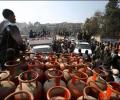
Cooking gas (LPG) dealers on Monday threatened to go on an indefinite strike from January 19 unless oil companies stop appointing new distributors.
Prime Minister Manmohan Singh and UPA chairperson Sonia Gandhi discussed the Rs 225,040 crore (Rs 2250.40 billion) revenue loss oil PSUs face without raising price of petrol, diesel, LPG and kerosene and duty cuts this fiscal on three occasions but failed to give a clear verdict.
The government on Wednesday rolled back its decision to hike LPG price by Rs 5 every month.
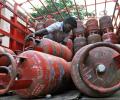
All households are entitled to get 12 cylinders of LPG or liquefied petroleum gas.
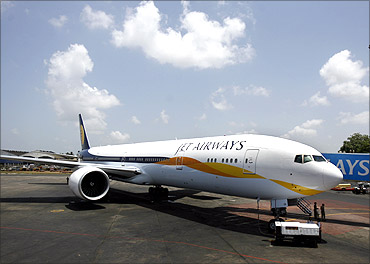
Jet fuel constitutes over 40 per cent of an airline's operating costs and the price cut will bring relief to the cash-strapped carriers.

Delhiites will have to shell out more from their pockets for virtually everything from cooking gas to diesel with Delhi government on Monday withdrawing subsidy on LPG and increasing VAT on many items to "generate" additional revenue.
Jet fuel (ATF) price was on Monday hiked by a steep 56.5 per cent and that of non-subsidised cooking gas LPG by Rs 11.5 per cylinder on the back of firming up of international oil rates, but petrol and diesel prices continued to remain on freeze for a record 78th day. Aviation turbine fuel (ATF) price was hiked by Rs 12,126.75 per kilolitre (kl), or 56.5 per cent, to Rs 33,575.37 per kl in the national capital, according to a price notification by State-owned oil marketing companies.

Oil prices have risen as freezing weather in the northern hemisphere has increased energy demand for heating.
Three fuel retailers -- Indian Oil Corporation, Bharat Petroleum Corporation Limited and Hindustan Petroleum Corporation Limited -- lost about Rs 26,618 crore (Rs 266.18 billion) in revenues on selling petrol, diesel, domestic LPG and kerosene below cost during the first half of the current fiscal, a ministry official said.
The government is likely to allow Reliance Industries Ltd to sell domestic cooking gas directly to bulk consumers in the country to overcome the problem of glut in LPG during lean season.
After being left unchanged for more than 10 months, diesel prices may see an increase of around Rs 2 per litre next month, providing marginal relief to the oil marketing companies (OMCs) that incur a loss of Rs 16.10 on selling every litre.
 © 2026 Rediff.com - Investor Information - Advertise with us - Disclaimer - Privacy Policy - Sitemap - Feedback - About us - Terms of use - Grievances